

Research Seminars
2026
Research Seminars in September
| 16 September | B323/1 | 13:00 - 14:30 |
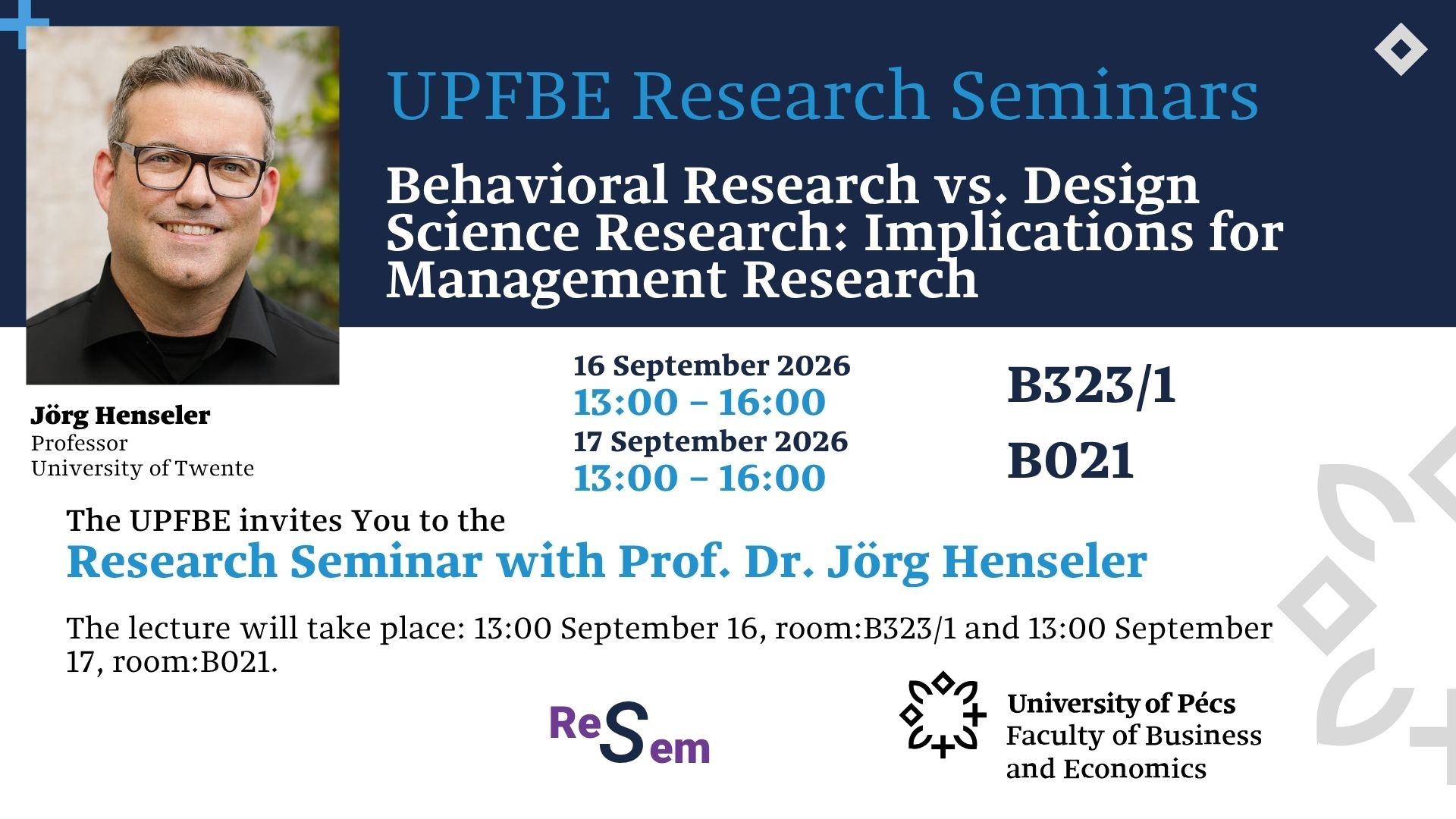
Dr. Jörg Henseler Title: Research Seminar: Behavioral Research vs. Design Science Research: Implications for Management Research Abstract: Keynote lecture examining the fundamental differences and complementarities between design-oriented and behavioural research paradigms, including episte-mological foundations, methodological choices, and the role of artefacts in scien-tific inquiry. | ||
| 16 September | B323/1 | 14:30 - 16:00 |
Title: Workshop: Design Thinking Abstract:Interactive workshop introducing participants to the five-stage Design Thinking process (Empathise – Define – Ideate – Prototype – Test) through a hands-on case study. The subsequent design thinking workshop will tackle several design methods that facilitate the process of empathizing with the problem owners, defining the challenge, ideating, prototyping, and testing. References | ||
| 17 September | B021 | 13:00 - 16:00 |
Title: Training Session: Behavioral Research vs. Design Science Research: Implications for Management Research Abstract: In-depth methodological session covering latent variable modelling, the distinc-tion between reflective and formative measurement models, and best practices for the specification and assessment of formative constructs. | ||
| 24 September | B311 | 13:00 - 14:30 |
Dr. Rolf Sternberg Title: Regional innovation policies in favor of doing-using interacting (DUI) innovations in lagging regions: What about the perceptions of local SMEs? Abstract: TBA | ||
Research Seminars in June
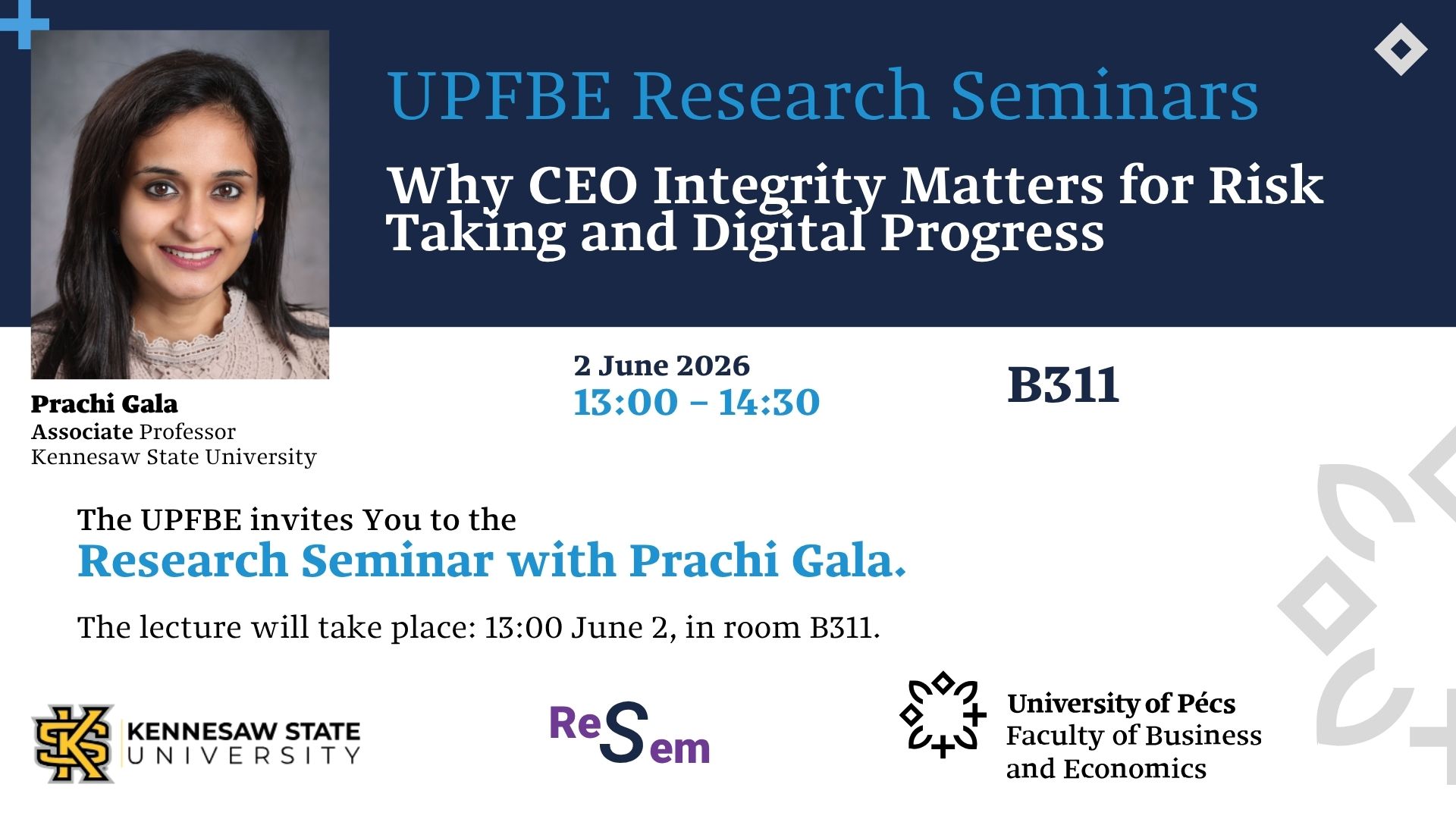
| 2 June | B311 | 1:00 - 2:30 pm |
Dr. Prachi Gala Title: Why CEO Integrity Matters for Risk Taking and Digital Progress Abstract: This research is an exploration of how Chief Executive Officer (CEO) integrity influences CEOs’ risk-taking propensity and subsequently the Digital Orientation (DO) of their firms. This study suggests that high integrity CEOs tend to have lower risk-taking propensity which subsequently leads to lower digital orientation in their firms. The negative impact of CEO integrity on DO is stronger in firms with high R&D intensity. However, high advertising intensity and the presence of Chief Marketing Officers (CMOs) in firms’ Top Management Teams (TMTs) attenuate this negative relationship. The findings of the study make a substantial contribution to an improved understanding of the multifaceted factors that are expediting digital adoption in organizations, offering valuable insights for marketing academics, board members, investors, employees, and customers. | ||
Research Seminar in May
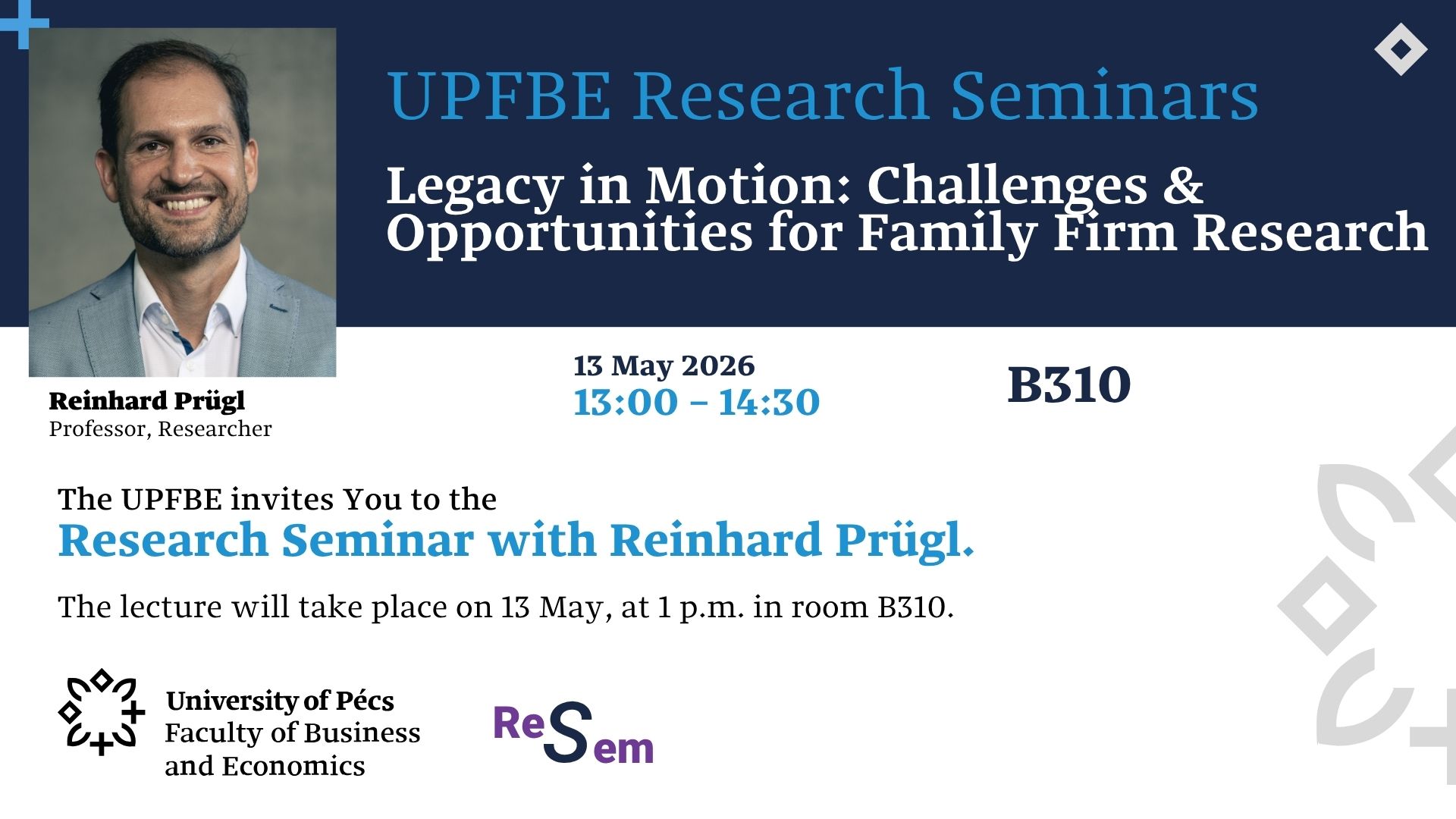
| 13 May | B311 | 13:00 - 14:30 |
Reinhard Prügl Title: Legacy in Motion: Challenges & Opportunities for Family Firm Research Abstract: Family firms are the dominant form of entrepreneurial action across the globe. Nevertheless, as research on family firms is still in an emerging state, many challenges and opportunities of family businesses and business families remain untackled. In this talk, we will talk about the importance of family firms for our economies in Europe a long with uncovering and problematizing (some) of the challenges and opportunities that those entrepreneurial units face currently, resulting in a discussion of pressing questions we need to tackle in order to further our knowledge on the future ability of family businesses and business families alike. | ||
Research Seminar in March
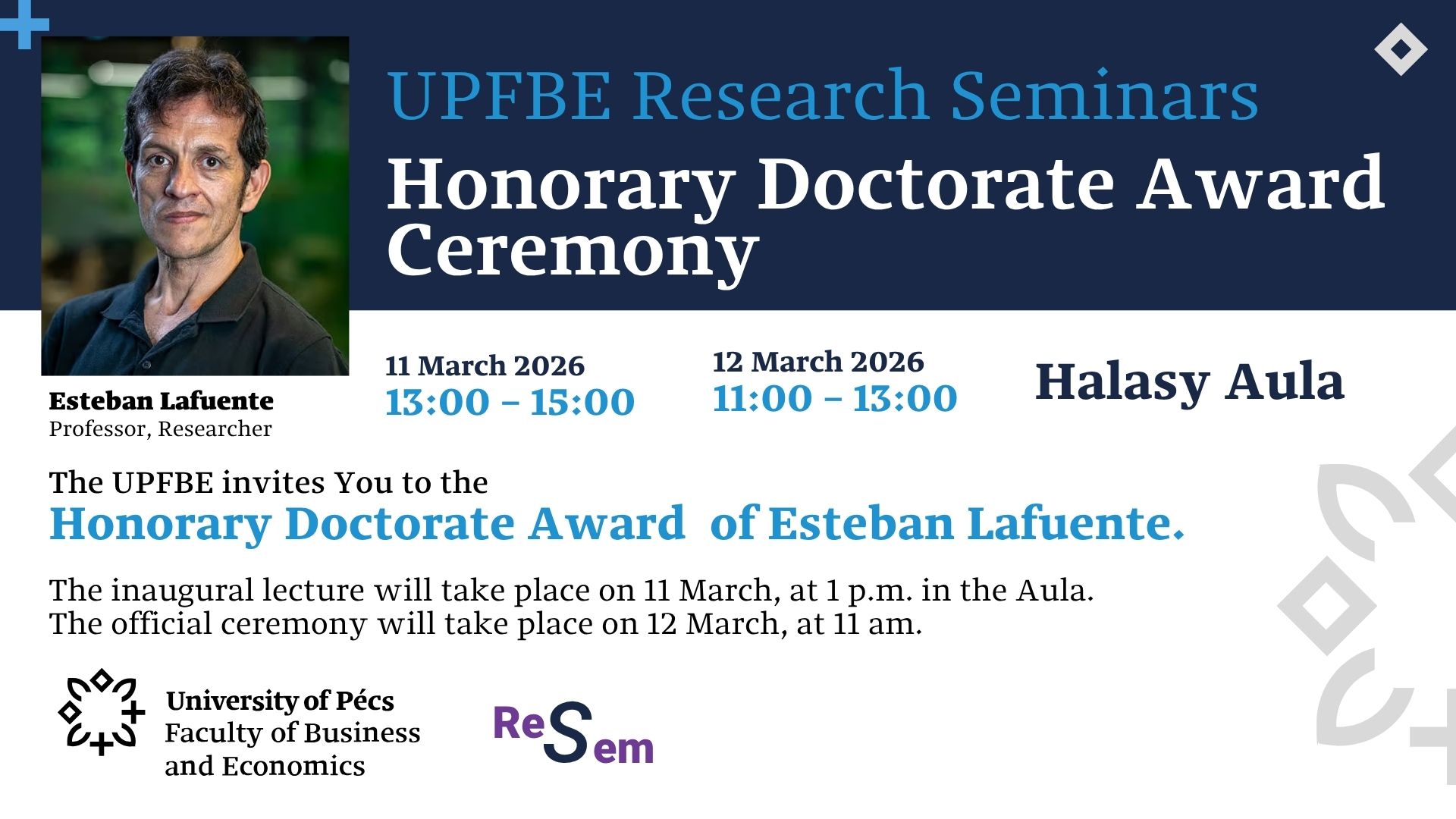
| 11 March | Halasy Aula | 13:00 - 14:30 |
Dr. Esteban Lafuente Title: Prof. Dr. Esteban Lafuente tudományos kutatásai Abstract: TBA | ||
2025
Research Seminars in Novemberben
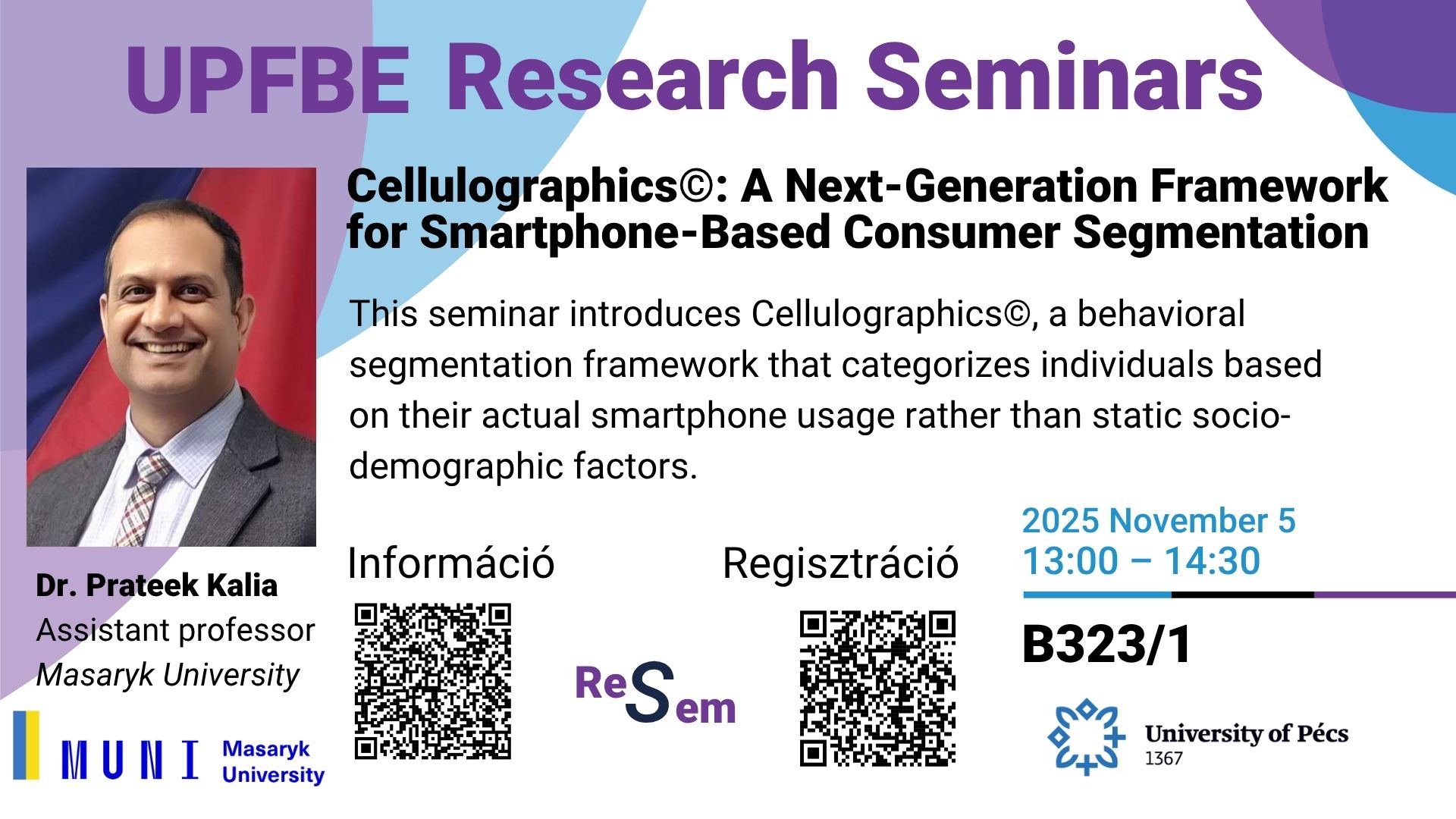
| November 5. | B323/1 | 13:00 - 14:30 |
Prateek Kalia PhD. Title: Cellulographics©: A Next-Generation Framework for Smartphone-Based Consumer Segmentation Abstract This seminar introduces Cellulographics©, a behavioral segmentation framework that categorizes individuals based on their actual smartphone usage rather than static socio-demographic factors. Traditional approaches, such as demographic, psychographic, and technographic lenses, often fall short in digital contexts. Cellulographics addresses this gap by concentrating on usage-level factors like experience and skills, frequency and duration of use, screen time, activities, and contexts or locations. I will outline the conceptual model, discuss measurement approaches, and demonstrate how Cellulographics complements the current technology-centric world, informing research in mobile commerce, HCI, digital health, and digital well-being. Empirical pathways include scale development and validation, segmentation-driven experiments, and cross-cultural comparisons. The session will highlight implications for both scholarship and practice, focusing on design, personalization, and policy. I will conclude by inviting colleagues to collaborate on joint projects and publications, including comparative studies leveraging datasets and field settings. | ||
| November 14. | B310 | 10:00 - 11:30 |
Dr. András Gyimesi Title: The importance of panel data and methods in economic research Description: Most research questions can be written in the form "how does x affect y?" In such cases, it is extremely important to eliminate endogeneity so that we can measure the effect of x on y with as little distortion as possible. I will review how a panel data set can help in this regard. Even if the data is available, it is still important to choose the right method. The most commonly used methods are difference-in-differences, fixed effect, first-difference, and dynamic panel methods. These will be presented, with particular emphasis on when it is appropriate to use them and when it is not. | ||

Research Seminars in September
A short summary of the programme is available here.
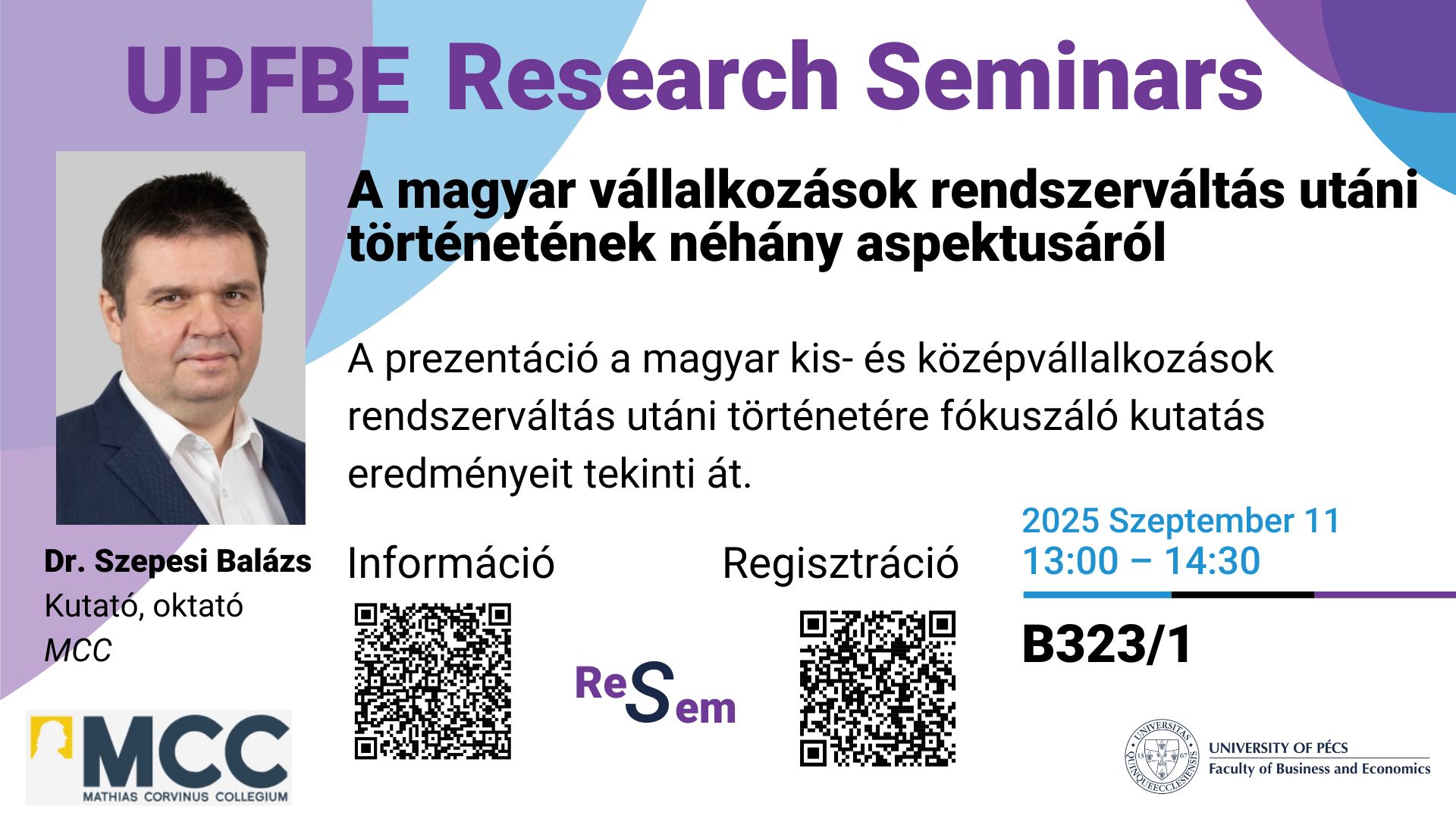
| Szeptember 11. | B323/1 | 13:00 - 14:30 |
Balázs Szepesi PhD Cím: Some aspects of the history of Hungarian businesses after the change of regime – beginnings, obstacles, driving forces, strategic focuses Absztrakt: The presentation reviews the results of research focusing on the history of Hungarian small and medium-sized enterprises after the transition to democracy. The MCC Business Research Workshop project draws on in-depth interviews, extensive literature review, and expert workshops to examine how the external environment affected the operation of businesses and what strategic responses determined the operation of companies based on their motivations. The presentation will present and discuss the preliminary results of a book chapter on the topic. | ||
Research Seminars in April
| Április 11. | B311 | 11:00 - 12:30 |
Manfred Paier Title: Exploring Regional Twin Transition Pathways with an Empirical Agent-Based Model Abstract: The twin transition—an integrated approach to digitalization and green innovation—is central to the European Union’s strategy for addressing climate change while fostering economic competitiveness. However, European regions exhibit significant heterogeneity in innovation capacities, industry structures, and institutional frameworks, affecting their ability to navigate this transition effectively. This ongoing project explores regional twin transition pathways by analysing the transformation of technological knowledge bases using an empirical agent-based model (ABM). We employ an ABM that simulates knowledge creation processes in 292 NUTS2 regions across Europe. The model represents 70,000 heterogeneous agents, characterized by sectoral affiliations, R&D intensities, and technological endowments, and specifies agent interactions for learning and knowledge exchange. It examines the mechanisms through which regions advance toward green and digital specialization, identifying pathways such as related and unrelated diversification, upgrading, and importation. By incorporating spatial microsimulation techniques and patent data from 2015–2020, we quantify regional specializations in green and digital technologies, allowing us to assess the impact of pre-existing capabilities on transition trajectories. First results indicate that regions with established green and digital knowledge bases predominantly follow related diversification, reinforcing existing expertise. Conversely, less technologically advanced regions rely on importation and unrelated diversification, facing greater structural challenges in transitioning toward twin specialization. Spatial spillover effects further influence transition dynamics, with advanced regions in Germany, Scandinavia, and Southern France leading the twin transition, while Eastern and South-Eastern European regions exhibit lagging trends. These findings highlight the evolutionary nature of technological transitions and the role of regional characteristics in shaping twin transition pathways. Future research will extend the model to assess policy interventions fostering interregional collaboration and diversification, providing insights for targeted innovation strategies. | ||
2024
Research Seminars in November
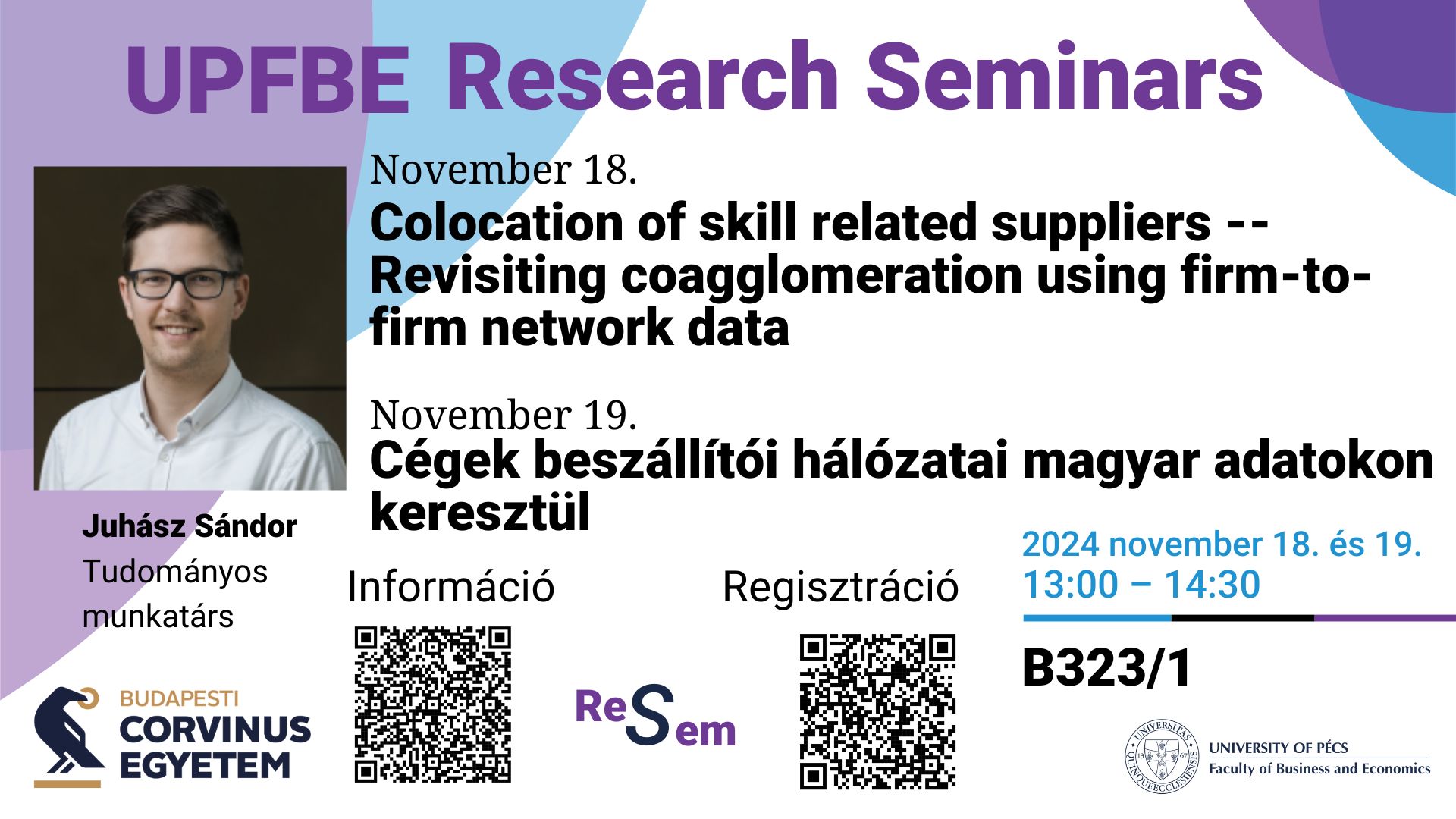
| November 18. | B323/1 | 1:00 - 2:30 pm |
Sándor Juhász Title: Colocation of skill related suppliers -- Revisiting coagglomeration using firm-to-firm network data Abstract: Firms in industry clusters benefit from locating close to their suppliers and customers. However, emerging global supply chains question the need for colocation to manage buyer-supplier relationships. We hypothesize that supply chain partners are more likely to colocate if they exchange not only goods but also know-how. Building on the literature of coagglomeration and using micro-data on the Hungarian economy, we study colocation, labor flows and value chain connections at the level of firms and pairs of industries. We show that supply chains are more likely to support colocation when the firms involved operate in skill related industries. | ||
| November 19. | B323/1 | 1:00 - 2:30 pm |
Juhász Sándor Cím: Cégek beszállítói hálózatai magyar adatokon keresztül Absztrakt: Magyarország azon kevés ország egyike, ahol a cégek ÁFA bevallásaiból származó adatok elérhetőek kutatási célokra. Ezek az adatok lehetővé teszik a beszállítói hálózatok vállalati szintű tanulmányozását a nemzetgazdaság egészében. Ez az előadás áttekintést nyújt ezekről az adatokról és felvillant néhány lehetőséget, amely az ÁFA adatok más adatbázisokkal való kombinálásából adódik a cégek, iparágak és régiók gazdasági kapcsolatainak tanulmányozására. | ||
Research Seminars in October
| Október 10. | B323/1 | 1:00 - 2:30 pm |
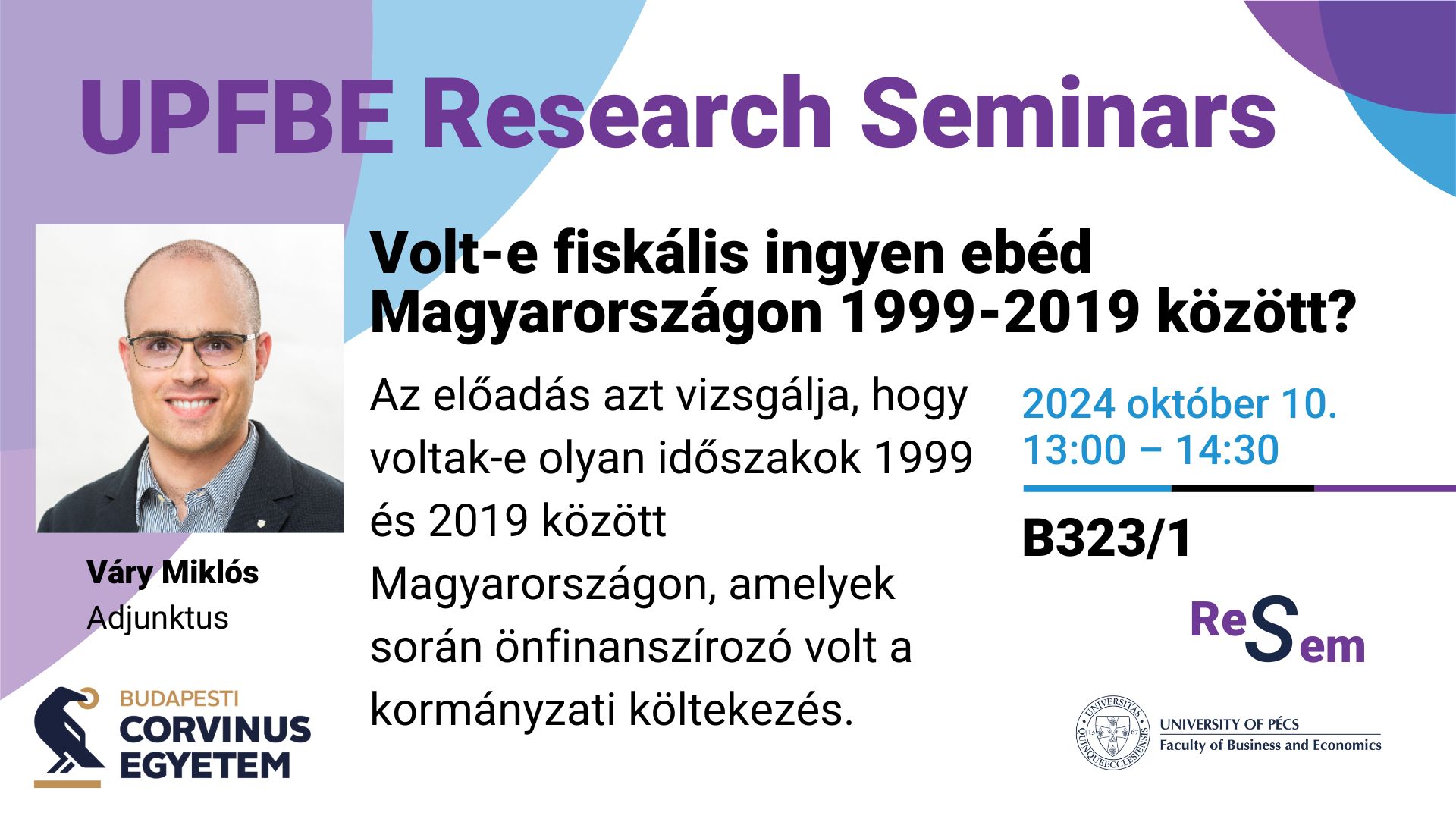
Dr. Váry Miklós Előadás témája: Volt-e fiskális ingyen ebéd Magyarországon 1999-2019 között?. Absztrakt: Az előadás azt vizsgálja, hogy voltak-e olyan időszakok 1999 és 2019 között Magyarországon, amelyek során önfinanszírozó volt a kormányzati költekezés. Ez egy olyan állapotot jelent, amikor a költségvetési deficit növekedése nem vezet a GDP-arányos államadósság növekedéséhez, mivel a deficit élénkíti a gazdasági teljesítményt is. Egy egyszerű adósságdinamikai modell paramétereinek becslésére kerül sor magyar adatokon, majd azt vizsgálja az előadás, hogy érvényes-e az előbbi érvelés egy feltörekvő, kis nyitott gazdaságra is, amilyen a magyar.
| ||
Research Seminars in September
A short summary of the programme is available here
| September 12. | B323/1 | 1:00 - 2:30 pm |
Dr. Tamara Keszey, Professor, Corvinus University - Institute of marketing, Department of Marketing, Budapest, Hungary Title: How to publish in international Q1 management journals? - The importance of research question, theoretical positioning and international embeddedness Abstract: TBA
| ||
Research Seminars in April
A short summary of the programme is available here.
| April 25. | B313 | 1:00 - 2:30 pm |
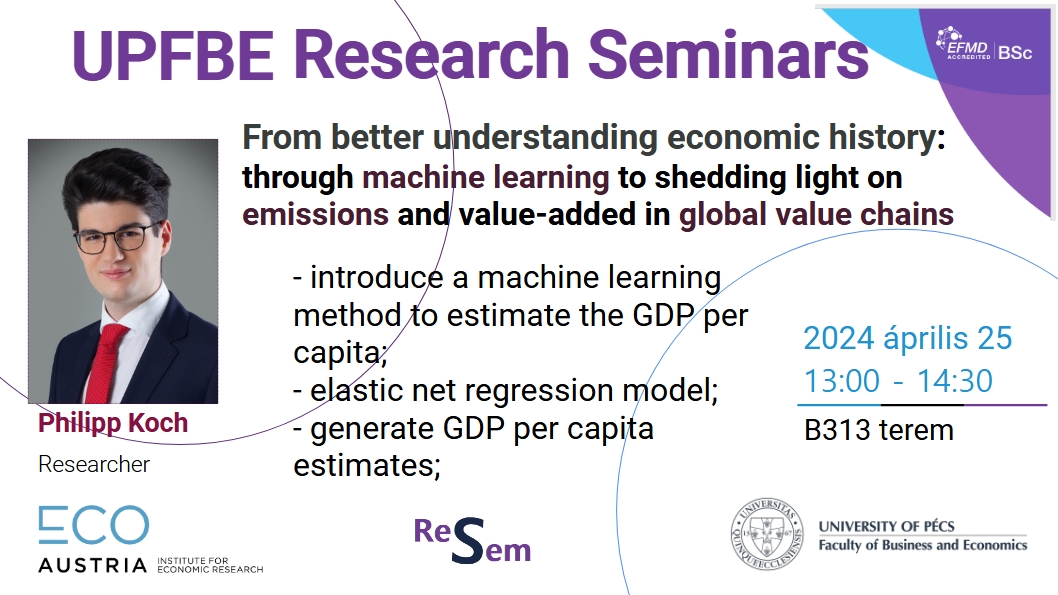
Philipp Koch, Researcher, EcoAustria - Institute for Economic Research, Vienna, Austria Title: From better understanding economic history through machine learning to shedding light on emissions and value-added in global value chains Abstract: Quadrupling historical GDP per capita estimates through machine learning. Can we use data on the biographies of hundreds of thousands of historical figures to estimate the GDP per capita of countries and regions? Here we introduce a machine learning method to estimate the GDP per capita of dozens of countries and hundreds of regions in Europe and North America for the past 700 years starting from data on the places of birth, death, and occupations of hundreds of thousands of historical figures. We build an elastic net regression model to perform feature selection and generate out-of-sample estimates that explain 85% of the variance in known historical GDPs per capita. We use this model to generate GDP per capita estimates for countries, regions, and time periods for which this data is not available and validate them by comparing them with three proxies of economic output: body height in the 18th century, wellbeing in 1850, and church building activity in the 14th and 15th century. Additionally, we show our estimates reproduce the well-known reversal of fortune between southwestern and northwestern Europe between 1300 and 1800. These findings validate the use of fine-grained biographical data as a method to produce historical GDP per capita estimates. We publish our estimates with appropriate confidence intervals together with all collected source data in a comprehensive dataset.
| ||
Research Seminars in March
A short summary of the programme is available here.
| March 20 | B311 | 1:00 - 2:30 pm |
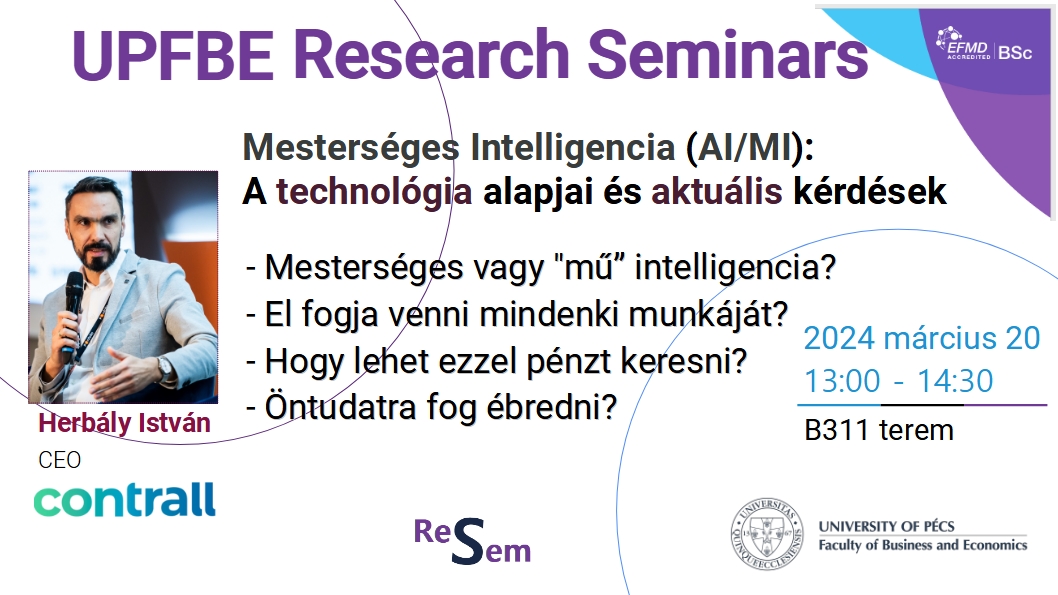
István Herbály, CEO, Contrall Ltd. Title: Artificial Intelligence: basics of the technology and current issues Issues: These are just some of the questions about Artificial Intelligence that many of us ask ourselves when we read or hear something about this technology almost every day. The aim of the workshop is to build a common knowledge base, followed by a joint discussion of questions like the above.
| ||
Research Seminars in February
A short summary of the programme is available here.
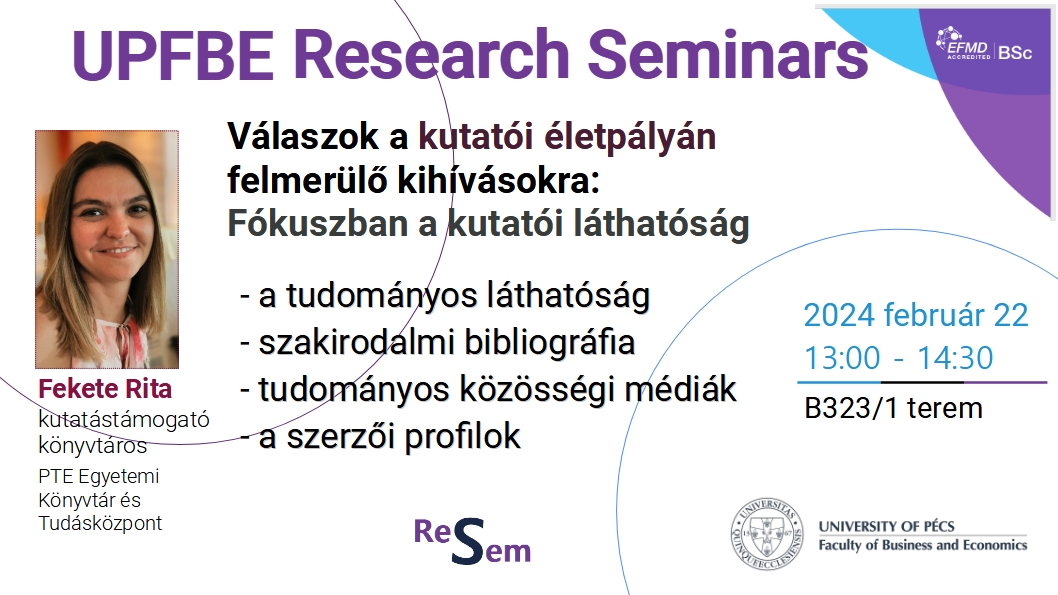
| February 22 | B323/1 | 1:00 - 2:30 pm |
Rita Fekete, research-support librarian, University of Pécs, Library and Knowledge Centre Title: Responses to the challenges of a research career: focus on researcher visibility Abstract:
| ||