


Vulnerability, specialisation and development pathways in global value chains
Principal investigator:

Professor, Vice Dean for Research, Director of Research
63150
sebestyent [at] ktk.pte.hu
B110
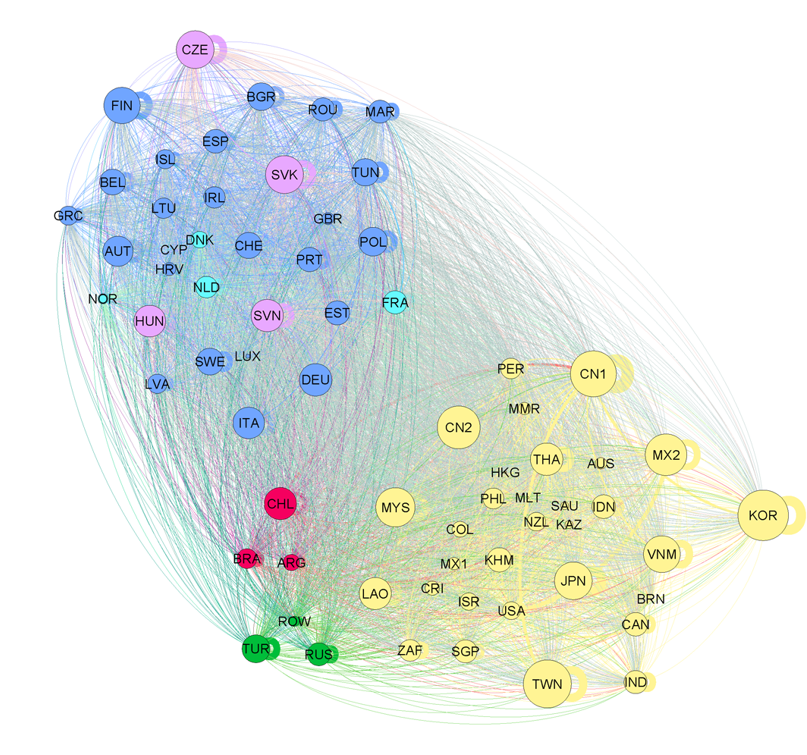
Source: own editing
Globalization and economic integration have reshaped production and trade, creating complex global value chains. While these complex value chains have contributed to efficiency and national incomes, they have also increased the interdependence and vulnerability of economies. Transition economies, particularly in Central and Eastern Europe, face unique challenges in this landscape. They often integrate into global value chains at lower value-added stages, leading to economic duality where advanced, foreign-owned sectors coexist with less productive domestic sectors. This dual economic structure exacerbates vulnerabilities and hinders upward mobility within global value chains. Addressing this duality and understanding the pathways to higher value-added production is therefore critical to enhancing economic stability and development in these regions.
The research develops diagnostic tools that capture the divide between foreign-owned and domestic firms. This helps to understand the nature and drivers of this specific economic structure and to identify possible development paths within global value chains. It also seeks to understand how economic resilience can be built together with a shift towards higher value-added economic activities. The research provides a comprehensive understanding of the dual economic structure and its implications for development and resilience. By identifying successful development pathways and the conditions that enhance resilience, the project will provide valuable guidance to policymakers navigating the complexities of globalization and economic integration.
The research team and results can be followed on the EconNet webpage.